.png)
Government cleaning contracts represent some of the most stable, recurring, and high-value work available to janitorial service providers. Federal office buildings, VA hospitals, courthouses, public schools, transit stations, and military facilities all require professional cleaning services, and they need them continuously, year after year. Yet most cleaning businesses assume this market is out of reach. It isn't. What it requires is knowing how the system works and showing up prepared. This guide breaks down exactly how to get cleaning contracts with the government, step by step.
Strategy 1: Register Your Cleaning Business and Get the Right Certifications
In order to get government cleaning contracts, the very first thing you need to do is make your business visible to the agencies that award them. Without registration, you cannot bid on federal janitorial contracts; it is a hard requirement, not a suggestion.
Start with SAM.gov registration
https://sam.gov is the federal government's official vendor database. Registration is mandatory before you can receive any federal cleaning contract award; it's free and takes about 30–60 minutes.
What you register:
- Legal business entity
- Tax ID / EIN
- Banking info
- NAICS codes
- Representations & certifications
- Small business certifications (if applicable)
Relevant NAICS for janitorial vendors:
- 561720 – Janitorial Services
- 561740 – Carpet & Upholstery Cleaning
- 561210 – Facilities Support Services
- 561790 – Other Services to Buildings
State Vendor Registration Portals (Mandatory for SLED)
Unlike federal, there is no single master portal. Each state usually requires suppliers to register in its procurement system.
Examples:
- California – Cal eProcure (supplier/vendor registration): Cal eProcure
- Texas – CMBL (Centralized Master Bidders List): Texas CMBL Registration
- Florida – MyFloridaMarketPlace (vendor registration): MyFloridaMarketPlace Vendor Information Portal
(Florida’s procurement vendor system) - New York – NYS Contract Reporter: NYS Contract Reporter Business Registry
- Pennsylvania – PA Supplier Portal: PA Supplier Portal
Applies to: State agencies, counties, cities, school districts
Beyond federal work, register on your state's eProcurement portal as well. Platforms like DemandStar (https://www.demandstar.com) and BidSync (https://www.bidnet.com) serve many state and local agencies.
Get certified to unlock set-aside contracts. Certifications give your cleaning business access to solicitations where only a small pool of qualified businesses can bid, dramatically reducing competition. All major SBA certifications are managed through https://certify.sba.gov. Key certifications to pursue:
- Small Business (SB), qualifies you for federal small business set-asides, which represent a large share of government janitorial contracts
- Woman-Owned Small Business (WOSB / EDWOSB), helpful for getting janitorial contracts in government programs reserved for women-owned businesses
- Service-Disabled Veteran-Owned Small Business (SDVOSB), a strong designation with dedicated set-aside cleaning opportunities
- HUBZone, if your cleaning business is in a Historically Underutilized Business Zone, this opens another category of lower-competition contracts
The time investment to get certified is one of the highest-return actions a janitorial company can take when entering the government market.
Strategy 2: Use Pre-RFP Intelligence Tools Like Pursuit.us
Here is a truth most cleaning companies never discover: by the time a government janitorial contract is officially posted as an RFP, the most prepared bidders have already been working on their strategy for weeks or months. They know the facility, understand the scope, and in some cases have already spoken informally with the contracting officer. That is what pre-RFP intelligence means, and it is one of the biggest competitive advantages available in order to get government cleaning contracts.
Pre-RFP intelligence means tracking upcoming janitorial opportunities before they are formally advertised. Specifically, you want to monitor:
- Incumbent contracts that are nearing expiration
- Agency facility expansion plans or new government buildings in your area
- Agencies that have historically awarded janitorial contracts in your service region
Pursuit.us (https://www.pursuit.us) is one of the best AI tools that reads, scans, and analyzes millions of government meeting documents, budget allocations, existing contracts, FOIA requests, and official documents to provide pre-RFP intel to facility and janitorial service companies.
This lead time is invaluable: you can visit the facility, research the incumbent's track record, and build a far stronger proposal than competitors who only learn about the opportunity on posting day.
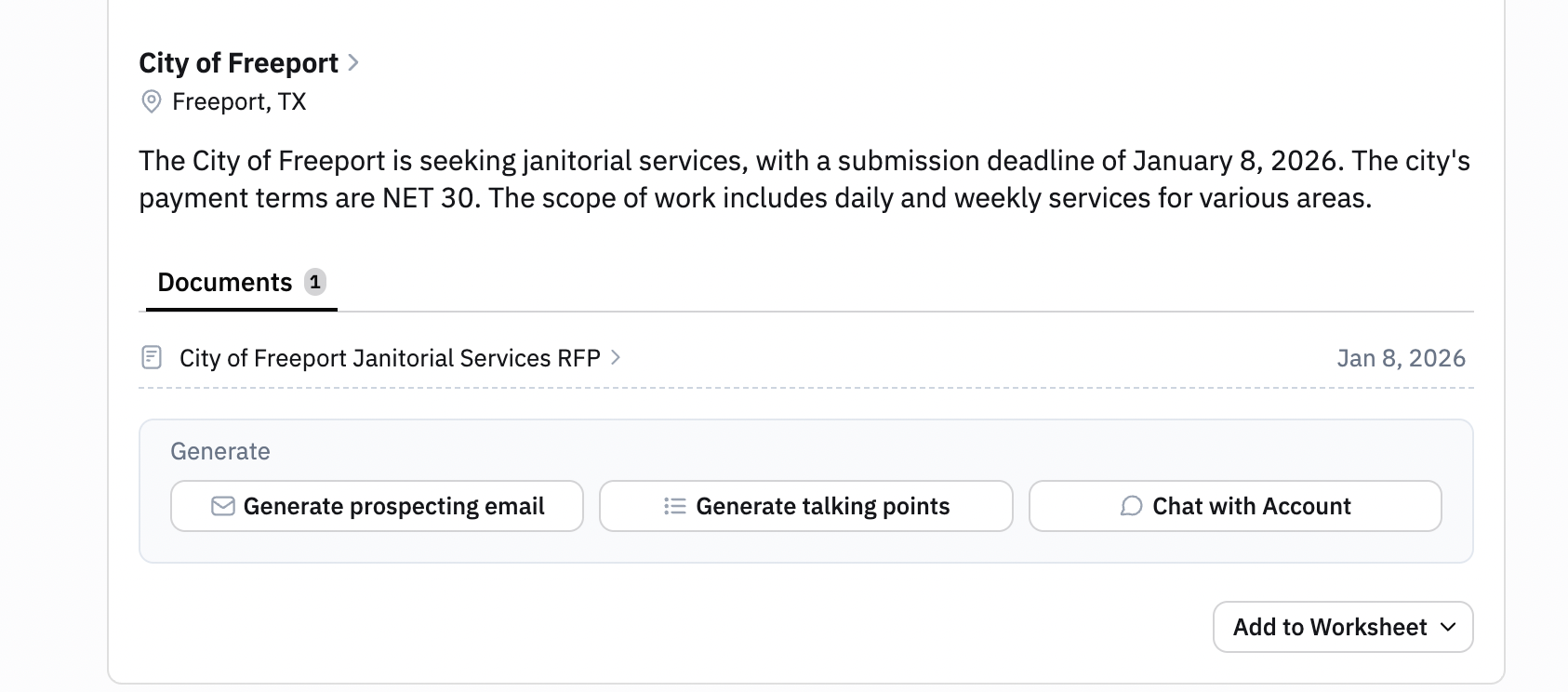
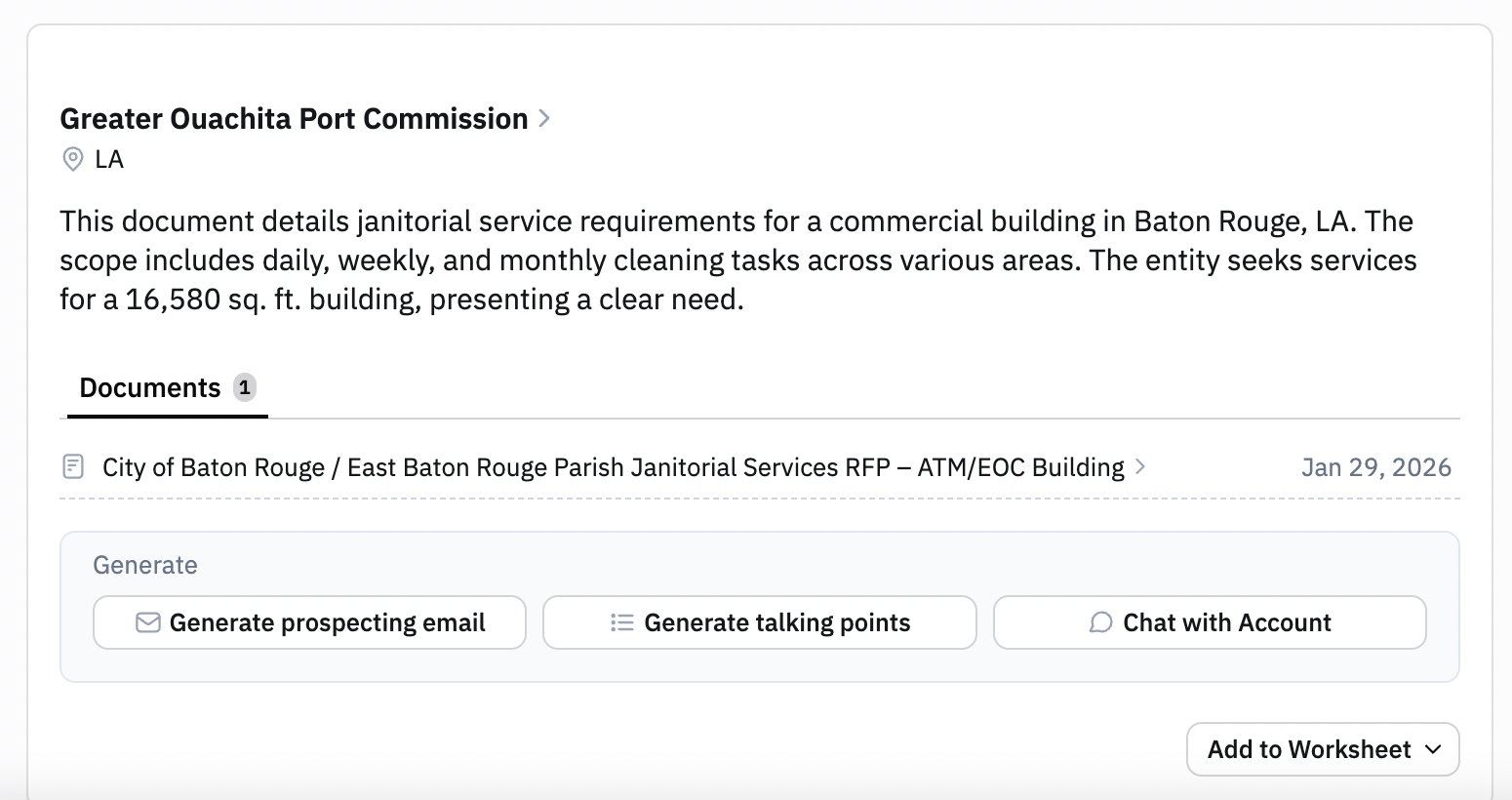
Here are some examples of cleaning service opportunities with governemnt from Pursuit.us's website.


Strategy 3: Start Local, City, County, and School District Contracts Are Easier Entry Points
A common mistake cleaning businesses make when trying to get government janitorial contracts is aiming directly at large federal agencies. Federal contracts can be highly competitive, carry strict bonding requirements, and often require documented past performance that a newer government contractor won't yet have.
Local government is a much smarter starting point. City halls, county courthouses, public libraries, municipal transit stations, parks and recreation facilities, and public schools all require regular janitorial services, and they procure them constantly. These contracts are typically smaller in scope, have lighter compliance requirements, and are significantly less competitive. More importantly, winning a local government janitorial contract gives you the documented past performance you need to pursue larger state and federal contracts later.
Platforms to find local government cleaning bids:
- BidNet Direct, https://www.bidnet.com
- DemandStar, https://www.demandstar.com
Also check your city and county's procurement or purchasing department website directly, many post solicitations there without listing them on third-party platforms.
Strategy 4: Hunt Bids Proactively Using Bid Aggregator Platforms
Don't wait for opportunities to find you. In order to get government cleaning contracts with any regularity, you need a consistent process for finding and reviewing open solicitations. Bid aggregator platforms collect active government solicitations from thousands of agencies across federal, state, and local levels into a single searchable database.
When reviewing a cleaning services solicitation, pay close attention to:
- Scope of work and total square footage covered
- Cleaning frequency and scheduling requirements
- Minimum bonding and insurance thresholds
- Whether the contract is a small business set-aside
- Who held the contract previously, incumbent information is often listed and gives you important context on pricing and performance history
Search using NAICS code 561720 on these platforms to filter to the most relevant janitorial contract opportunities. Useful platforms for proactive bid hunting:
- BidSync, https://www.bidnet.com
- Periscope S2G, https://www.periscopes2g.com
- SAM.gov Contract Search, https://sam.gov/search/
- USASpending.gov, https://www.usaspending.gov (not a bid board, but useful for researching agency spending history on janitorial services)
Strategy 5: Study Past Janitorial Contract Awards Before You Bid
One of the most underused strategies for getting government cleaning contracts is researching past awards before writing a single word of your proposal. Before investing time in a bid, you should know: who won this type of contract before, how much they charged, how long the contract ran, and whether there were any reported performance issues.
This research helps you in several ways:
- Price competitively, not so high you lose on cost, not so low you operate at a loss
- Understand what the agency values in a cleaning contractor
- Assess whether the current incumbent is vulnerable, which tells you how winnable the recompete will be
For federal janitorial contracts, search by NAICS code 561720 on these platforms:
- USASpending.gov, https://www.usaspending.gov
- FPDS.gov (Federal Procurement Data System), https://www.fpds.gov
- SAM.gov Awards Search, https://sam.gov/search/
For state and local cleaning contracts, check your state's transparency or open data portal, most states publish contract award data publicly.
Strategy 6: Write a Proposal That Actually Wins Government Cleaning Contracts
Price matters in government janitorial bids, but it is not the only thing that matters. Many government cleaning contracts are evaluated on a "best value" basis, meaning agencies weigh technical approach, past performance, staffing plan, and quality control methodology alongside price. A cleaning company that bids lowest but submits a vague or poorly organized proposal will often lose to a moderately priced competitor with a well-written submission.
A strong government cleaning services proposal typically includes:
- A direct response to every line item in the scope of work, never leave anything unaddressed
- Your proposed staffing plan including supervisor-to-worker ratios
- A cleaning frequency schedule and methodology broken down by area type (restrooms, common areas, offices, etc.)
- Proof of insurance and bonding meeting the solicitation's minimums
- Green cleaning certifications or LEED-aligned product lists, where relevant, many agencies view these favorably
- Past performance references with contract numbers, agency contacts, period of performance, and measurable outcomes
Common reasons cleaning company bids get disqualified:
- Missing required forms or attachments
- Failing to meet minimum insurance or bonding thresholds
- Not responding to every section of the RFP
- Submitting after the deadline
Read the solicitation document carefully, multiple times, before writing anything. Proposal software can help manage the process if you are bidding on multiple janitorial contracts at once:
- Loopio, https://www.loopio.com
- Responsive, https://www.responsive.io
These tools let you build a content library of reusable sections, company overview, past performance write-ups, team bios, so you're not starting from scratch on every government cleaning bid.
Strategy 7: Attend Pre-Bid Site Visits and Government Procurement Events
Many government janitorial contract solicitations include a pre-bid walkthrough of the facility. While attendance is often listed as optional, treating it that way is a mistake. For cleaning services contracts, especially, the physical facility is everything. Square footage on paper is not the same as understanding the actual layout, flooring types, restroom conditions, supply delivery access, or security clearance requirements. Attending gives you information that competitors who skip it simply won't have.
It also puts you in the room with the contracting officer and facility manager. Procurement officers remember the cleaning company representatives who showed up, asked good questions, and demonstrated genuine interest in the work. This is not about schmoozing; it is about building name recognition that makes your proposal feel familiar when evaluators review it.
Beyond site visits, these events are valuable for janitorial businesses trying to build government relationships:
- SBA Matchmaking Events, https://www.sba.gov/events, connect small cleaning companies with contracting officers and prime contractors
- GSA Small Business Events, https://www.gsa.gov/about-us/events-and-training
- Your regional PTAC, https://www.aptac-us.org, can tell you about upcoming local procurement events in your area
Strategy 8: Subcontract Under a Prime Contractor to Land Your First Government Cleaning Contract
If your cleaning company has no documented government past performance, breaking in as a prime contractor can be an uphill climb. One of the most effective ways around this is starting as a subcontractor.
Large facility management firms and prime service contractors that win major government facility contracts often have mandatory small business subcontracting requirements written into their agreements; they are required to bring in small, minority-owned, or veteran-owned cleaning subcontractors to perform a portion of the work. This is a legitimate, well-established entry point specifically designed to help smaller janitorial businesses get into government work.
Once you complete the subcontract, you have a real, citable past performance record, experience with government facility cleaning standards, and a reference who can vouch for your work, all of which help you win your next government cleaning contract as a prime.
To find subcontracting opportunities:
- SBA SUB-Net, https://eweb1.sba.gov/subnet, a free database where prime contractors post subcontracting needs
- USASpending.gov, https://www.usaspending.gov, identifies large prime contractors winning janitorial contracts in your area, then reach out directly
- SAM.gov, https://sam.gov, look up prime contractor profiles and contact them about subcontracting opportunities
Strategy 9: Use Your PTAC, A Free Resource Most Cleaning Businesses Don't Know Exists
If there is one resource most underused by janitorial companies trying to get government cleaning contracts, it is the Procurement Technical Assistance Center, known as a PTAC. PTACs are government-funded advisory centers located in every state, specifically designed to help small businesses navigate government contracting. Their services are completely free.
A PTAC counselor can help your cleaning business with:
- SAM.gov registration and profile optimization
- Identifying the right NAICS codes for your janitorial services
- Finding relevant bid opportunities in your area
- Reviewing your proposal before you submit it
- Understanding bonding, insurance, and compliance requirements
The only reason more cleaning businesses don't use PTACs is that they simply don't know they exist. Find your nearest PTAC through the APTAC directory at https://www.aptac-us.org. Schedule a free consultation before you pursue your next government cleaning contract; the guidance from a single session can save months of trial and error.
Strategy 10: Build a Past Performance Record That Opens Doors to Bigger Cleaning Contracts
In government procurement, past performance is often the deciding factor between two otherwise competitive janitorial bids. Contracting officers want assurance that the cleaning company they are awarding to has done this work before and done it well. Without a strong past performance record, even the most capable cleaning business will struggle to win government contracts consistently.
Past performance does not have to come exclusively from federal janitorial contracts. Work performed for state agencies, county governments, school districts, transit authorities, hospitals, and large commercial clients can all be used to demonstrate relevant experience, especially early on. What matters is documenting it properly. For each past contract, record:
- Client name and a reference contact with current contact information
- Contract value and period of performance
- Total square footage maintained
- Any measurable quality outcomes, inspection scores, contract renewals, zero complaints, customer satisfaction ratings
- Your quality control processes, internal inspection procedures, supervisor oversight, corrective action protocols
Government clients appreciate cleaning companies that have documented quality control systems. Software tools like Swept (https://www.sweptworks.com) and Janitorial Manager (https://www.janitorialmanager.com) help cleaning businesses document inspections and track quality in a way that can be directly referenced in future government proposals.
Where to Start
You don't need to execute all 10 strategies at once. For most janitorial companies starting out in government work, the recommended priority order is:
- Register on SAM.gov (https://sam.gov) and your state's vendor portal
- Apply for relevant SBA certifications at https://certify.sba.gov
- Set up Pursuit.us (https://www.pursuit.us) to track early contract opportunities
- Target local city and county janitorial contracts to build your first past performance records
The learning curve in government contracting is front-loaded. The first government cleaning contract is the hardest to win. After that, documented past performance, established agency relationships, and proposal-writing experience all compound, and each successive bid becomes significantly easier. Contact your local PTAC at https://www.aptac-us.org today for a free consultation. It is the single highest-value first step any cleaning business can take.
Identify buyers 6–18 months before RFP drops
170K+ SLED entities tracked 24/7 with AI
Auto-syncs deal signals to your CRM
Active buyer signals delivered daily on emails and Slack
Free Chrome extension for instant intel
Decision makers’ contact info with ready-to-use outreach drafts
Trusted by 200+ govtech teams
Compare Pursuit vs. Starbridge across pricing, integrations, pre-RFP intelligence, churn risk, and more to see why Pursuit is the best Starbridge alternative for B2G sales teams.
Read blog postLooking for Starbridge alternatives? Explore the 5 best Starbridge competitors in 2026, including Pursuit.us, GovWin, GovSpend, GovSignals, and GovTribe, compared by features, data depth, and fit for SLED sales teams.
Read blog postDiscover the 24 best landscaping and snow removal companies for government buildings, each with verified experience serving city, county, state, and federal clients.
Read blog post