If you’re a vendor planning to submit your proposal to an RFP, this checklist is for you.
Every RFP response looks simple at first, until you’re two days away from the deadline and suddenly chasing signatures, compliance documents, attachments, forms, and formatting rules.
There are dozens of small (and big) things you must verify before submitting your proposal. In many cases, proposals are rejected not because of poor technical merit, but because of:
- Missing forms
- Incorrect file naming
- Incomplete certifications
- Unsigned documents
- Page limit violations
- Non-compliance with submission instructions
That’s exactly why we created this RFP Checklist (also called a RFP Response Checklist, Vendor Submission Checklist or RFP Preparation Checklist), to make sure you don’t lose contracts over avoidable administrative errors.
RFP Response Checklist for Vendors: Free Template (Excel)
What is it: After going through hundreds of RFPs and speaking with vendors who consistently win SLED and federal contracts, we noticed a clear pattern:
Winning vendors don’t just write strong proposals.
They manage compliance with precision.
That’s why we created this structured RFP Preparation Checklist (RFP Response Checklist) with nearly 90 essential checkpoints covering administrative, technical, financial, and compliance areas.
👉 RFP Preparation Checklist for Vendors - Template (Google Sheet)
To use it,
Option 1: File-->Download-->Microsoft Excel
Option 2: Copy-Paste the entire checklist sheet to your Excel or Google Sheets.
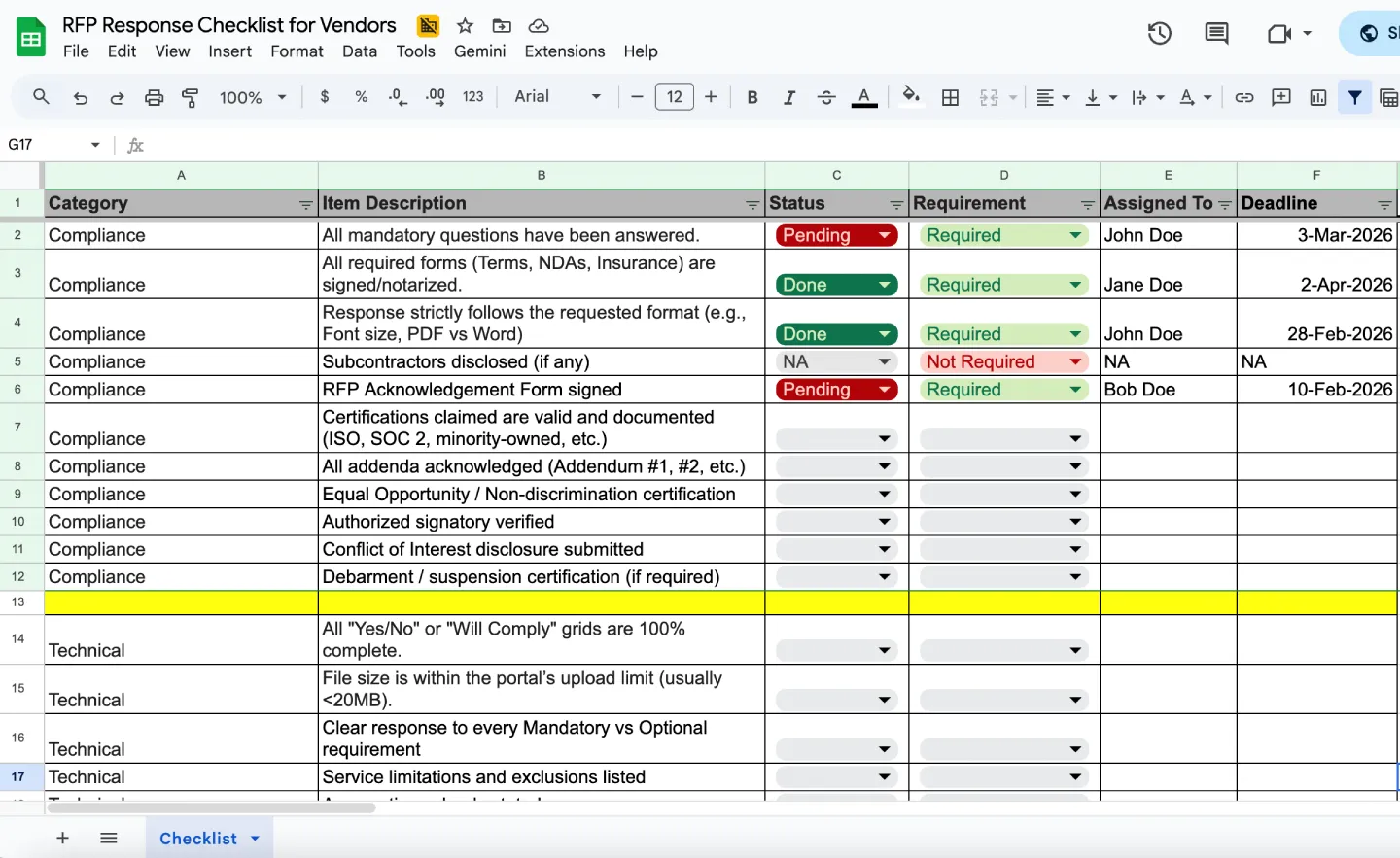
How to Navigate the RFP Response Checklist Template
The Excel sheet is structured to be practical, flexible, and easy to use across industries (SLED, federal, commercial).
Here’s how each column works:
1. Category Column
We’ve organized the checklist into 10 distinct categories, with a brief explanation of each provided in the next section. This structure makes it easier to assign responsibilities across departments such as legal, finance, sales, technical, and leadership.
2. Description
A clear explanation of what needs to be completed. We have included approx. 90 checkpoint descriptions.
For example:
- Confirm mandatory forms are signed
- Verify SAM registration (if applicable)
- Ensure pricing format matches RFP instructions
- Validate page limits and formatting compliance
This eliminates ambiguity and ensures everyone understands what “done” actually means.
3. Status (Dropdown Enabled)
We’ve included a dropdown with visual indicators:
- Pending (Red)
- Done (Green)
- Not Required
This allows you to quickly filter tasks and monitor readiness before submission day.
4. Requirement Column
Not all RFPs require the same documents.
If a checklist item doesn’t apply to your specific RFP, simply select “Not Required” from the dropdown. This keeps your sheet clean and avoids confusion.
5. Assigned To
One of the biggest reasons RFPs get delayed internally?
No clear ownership.
Use this column to assign responsibility for each task. Accountability prevents last-minute chaos.
6. Deadline
Add internal deadlines (not just the RFP deadline).
Best practice:
- Set internal completion 5-7 days before submission.
- Leave buffer time for executive review and technical upload issues.
Optional Columns You Can Add (Recommended)
Depending on your internal workflow, you may want to expand the template. Here are some useful additions:
✔ Confidence Level (High / Medium / Low)
Helps leadership quickly assess risk areas in the proposal.
✔ Document Location / Link
Add a SharePoint / Google Drive link for easy retrieval.
✔ Reviewer / Approver
Track who reviewed the item for quality control.
✔ Compliance Reference
Mention page/section number of the RFP where the requirement appears.
✔ Version Number
Especially useful when multiple drafts are circulating.
✔ Notes / Comments
Capture clarifications, open questions, or agency communications.
✔ Risk Flag
Mark items that could potentially disqualify the submission.
10 Main Sections of RFP Response Checklist
Winning an RFP is not just about writing a strong technical response. It’s about managing compliance, risk, coordination, pricing logic, and positioning — all at the same time.
Below are the major sections included in the checklist, along with why each matters and practical tips to avoid common mistakes.
1. Compliance
Why It’s Needed: Compliance is your entry ticket. If you fail here, evaluators may not even score your proposal. Many RFPs use pass/fail compliance screening before technical evaluation begins.
Common Compliance Items
- Mandatory forms completed
- Signed certifications
- Addenda acknowledgment
- Submission format adherence
- Page limits respected
Tips & Hacks
- Create a “Compliance Matrix” mapping each RFP requirement to your response section.
- Double-check submission portal rules (file size, naming format, allowed file types).
- Acknowledge every addendum explicitly, missing one can disqualify you.
Caution
Never assume “minor formatting issues” will be overlooked. They often aren’t.
2. Technical
Why It’s Needed: This is where you prove you can actually deliver. Technical scoring usually carries the highest weight in evaluation.
What to Check
- All functional requirements addressed
- Clear methodology and approach
- Assumptions stated
- Deliverables defined
- Scope alignment
Tips & Hacks
- Mirror the RFP language in your headings.
- Avoid generic marketing copy; evaluators want direct answers.
- If a requirement is optional, still address it strategically.
Caution
Do not overpromise. Over-commitment can backfire during contract negotiation or implementation.
3. Administrative
Why It’s Needed: Administrative mistakes are one of the top reasons proposals get rejected.
What to Verify
- Company information accuracy
- DUNS/UEI/SAM details (if federal)
- Contact person correctness
- Submission instructions followed
- Required attachments included
Tips & Hacks
- Assign one person as “Administrative Gatekeeper.”
- Use internal submission deadlines 3–5 days before actual due date.
- Verify time zone of submission deadline.
Caution
Last-minute uploads often fail due to portal issues. Never submit at the exact deadline.
4. Security, Privacy & Risk
Why It’s Needed: Especially critical in SLED and federal contracts. Agencies want assurance that you won’t create operational, legal, or cybersecurity risks.
Checklist Focus
- Data protection policies
- Security certifications (SOC 2, ISO, etc.)
- Incident response plan
- Business continuity plan
- Insurance coverage
Tips & Hacks
- Maintain a reusable “Security Package” folder for quick access.
- Clearly explain how you mitigate risk, not just that you comply.
Caution
Vague statements like “we follow industry standards” are weak. Be specific.
5. Implementation & Delivery
Why It’s Needed: Agencies want to know: “How fast can you deploy? How smoothly?”
What to Include
- Timeline & milestones
- Project governance structure
- Roles and responsibilities
- Onboarding process
- Training approach
Tips & Hacks
- Provide a visual timeline (Gantt-style summary if allowed).
- Identify risks and mitigation strategies proactively.
- Show you’ve implemented similar projects before.
Caution
Unrealistic timelines reduce credibility.
6. Commercials & Pricing
Why It’s Needed: Pricing is not just about being the cheapest, it’s about being defensible.
What to Check
- Pricing format matches RFP
- All cost components included
- Taxes clarified
- Optional services separated
- Assumptions documented
Tips & Hacks
- Ensure pricing aligns with your technical proposal scope.
- Explain value, not just numbers.
- Check for math errors, even minor calculation mistakes hurt credibility.
Caution
If pricing format is specified, do not modify the structure.
7. Legal & Contractual
Why It’s Needed: This section determines long-term risk exposure.
Checklist Items
- Review of contract terms
- Exceptions documented
- Indemnity clauses evaluated
- IP ownership clarified
- Payment terms reviewed
Tips & Hacks
- Have legal review early, not 24 hours before submission.
- Track deviations separately for negotiation stage.
Caution
Never ignore problematic clauses assuming “we’ll fix it later.”
8. Experience, References & Proof
Why It’s Needed: Evaluators want evidence, not claims.
What to Include
- Past performance examples
- Relevant case studies
- Client references
- Performance metrics
- Team bios
Tips & Hacks
- Tailor case studies to match the agency’s industry.
- Provide measurable results (cost savings, time reduction, efficiency gains).
Caution
Do not use irrelevant references just to fill space.
9. Differentiation (Scoring Booster)
Why It’s Needed: Most vendors meet requirements. Few stand out. This section is about maximizing scoring beyond compliance.
Ways to Differentiate
- Innovation approach
- Value-added services
- Risk reduction strategies
- Long-term partnership vision
- Local presence (for SLED)
Tips & Hacks
- Add a short “Why Choose Us” summary.
- Highlight competitive advantages subtly within technical sections.
- Address agency pain points directly.
Caution
Avoid overly aggressive competitor comparisons unless explicitly requested.
10. Final Quality Check
Why It’s Needed: Before submission, your proposal must pass an internal audit.
What to Verify
- All sections complete
- Formatting consistent
- No placeholder text left
- Signatures included
- Files correctly named
- Final PDF validated
Final Thoughts
An RFP Response Checklist is not just a document, it’s a discipline.
Vendors who consistently win contracts don’t rely on memory or email threads. They rely on structured systems.
Use the Excel template as your control center, and treat compliance as seriously as technical excellence.
In 2026, precision wins.
Identify buyers 6–18 months before RFP drops
170K+ SLED entities tracked 24/7 with AI
Auto-syncs deal signals to your CRM
Active buyer signals delivered daily on emails and Slack
Free Chrome extension for instant intel
Decision makers’ contact info with ready-to-use outreach drafts
Trusted by 200+ govtech teams
Compare Pursuit vs. Starbridge across pricing, integrations, pre-RFP intelligence, churn risk, and more to see why Pursuit is the best Starbridge alternative for B2G sales teams.
Read blog postLooking for Starbridge alternatives? Explore the 5 best Starbridge competitors in 2026, including Pursuit.us, GovWin, GovSpend, GovSignals, and GovTribe, compared by features, data depth, and fit for SLED sales teams.
Read blog postDiscover the 24 best landscaping and snow removal companies for government buildings, each with verified experience serving city, county, state, and federal clients.
Read blog post